In lane Authors & Interviews
A Purple Elephant Crashes the Family Home in Tony Wilson's Idiom-Packed Picture Book
Description
Tony Wilson and Laura Wood's The Elephant in the Room turns a famous idiom into a rhyming family romp, with hidden sayings on every page. Out 1 December.

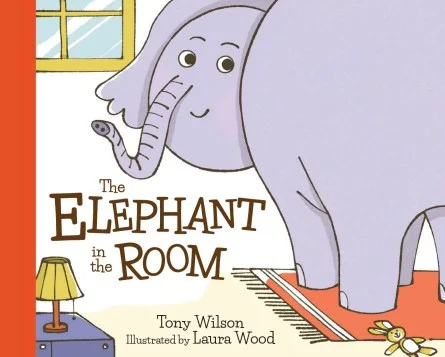
Most picture books hide one good joke. The Elephant in the Room hides dozens. Tony Wilson's latest takes the idiom everyone knows and makes it the literal centre of a chaotic household, then lets illustrator Laura Wood scatter other sayings through every spread for readers to find. It's a book about language that doesn't feel like a lesson, and that's harder to pull off than it sounds.

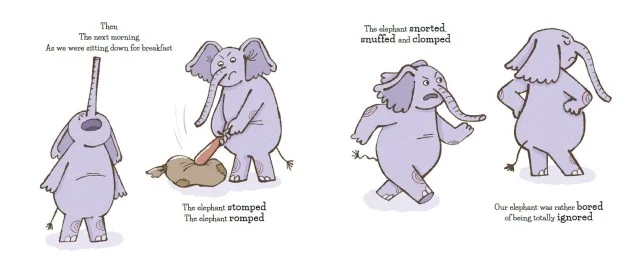
The setup is simple. A busy family goes about its day, each member caught up in their own noisy, slightly mischievous routine, while a large elephant wanders from room to room and gets ignored. Nobody quite acknowledges her. Eventually she has had enough, and she makes her presence felt in a very elephantine way. Wilson writes it in rollicking rhyming quartets, and the verse does most of the heavy lifting. Kids are invited to stomp, romp, snort, snuff and clomp along with the text.

Wilson's favourite passage shows the method at work:
"The elephant stomped, the elephant romped / The elephant snorted snuffed and clomped / Our elephant was rather bored / Of being totally ignored / And so she ambled to the sink / And had herself a mighty drink / Lifted up her mighty nose / And used it as a mighty hose."
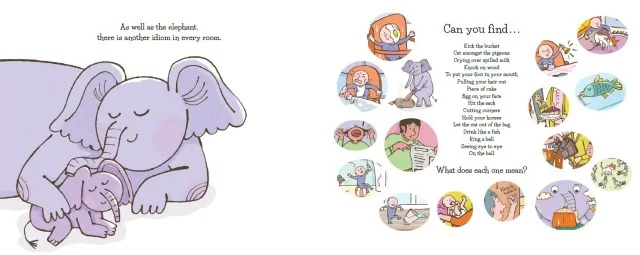
He says he likes the shift in rhythm and rhyme when the elephant asserts herself. Here's the thing: that moment is where the book turns, and the verse changes gear just as the story does. Wilson calls it funny, rhythmic and climactic, and the scene is hard to argue with. The final illustration of that sequence, with an airborne fish that is literally "drinking like a fish," is one of those details that rewards a second read.
The idioms hiding in plain sight
Wood's job was to make the idioms visible without making them feel like homework. A handy list of them sits at the start of the book, which helps parents and teachers who want to pull the sayings out after the first read. Readers will spot things like the child with a fried egg on her face, and the more they look, the more they find. The soft pastel palette keeps the mood warm, and the simple, cartoonish figures give every character something to do on every page.
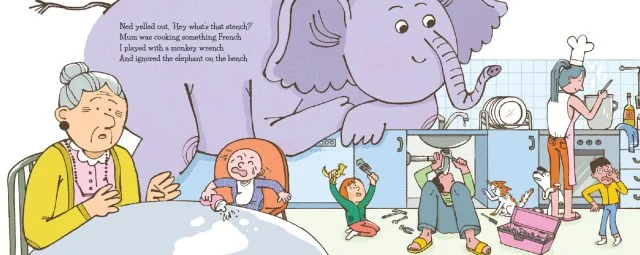
Wilson's reading of the colour choices is interesting. In early drafts the elephant was grey. The move to purple, he says, lifted the colour and mood of each page. It's a small change on paper, but it does a lot of work. A grey elephant would have sat in the background of a domestic scene. A purple one stands out, and that matches the book's central joke about something too big to overlook.
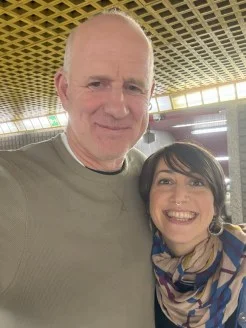
The design was handled by Sandra Nobes at Allen & Unwin, whose work Wilson admires, particularly her font choices. Wilson and Wood have now made five picture books together, despite living on different continents. Wood is based in Milan and Wilson in Melbourne, which is a remarkable working arrangement for a book this tightly coordinated between text and image.

The ending that took fifteen years
Wilson first wrote a version of this book about fifteen years ago, and he tested it on children during school visits. He's candid about what worked and what didn't. The room-by-room structure and the rhyme pattern that let kids shout out where the elephant was always landed well. The ending didn't. In early drafts the family was overwhelmed by the elephant and then carried on ignoring her, a bleak tagline closer to a Monty Python sketch. Grade 1 students weren't having it.
The finished version resolves the house guest problem in a way that suits younger readers. Wilson says the idea of putting an idiom on every page came later, last year, and he credits Wood with nailing it. He thinks that layer is the secret to the book's success. It's a useful lesson for anyone who has a strong premise stuck without a conclusion: sometimes the missing piece is a structural device that arrives late.
Wilson's own reading of the book's purpose is worth noting. He sees it as a story about facing problems before they multiply, and about talking things through. Wilson describes it as encouraging openness and clear lines of communication, while the wordplay runs quietly in the background. Older children, he suggests, will pick up what the idioms mean and which others are tucked into the artwork.
What kids are likely to make of it
Wilson has read rough versions aloud in classrooms, and the audience response shaped the final text. Younger children love joining in on the last word of each four-line, same-rhyme stanza. He lists the chorus-style endings as BENCH, POOL, BED and STAIR, which are exactly the sort of words small children shout back with glee. He also points to the warts-and-all family life as a source of appeal. Kids are getting dacked, parents are losing their marbles, and toothpaste is spread across the bathroom. Wilson thinks young readers will recognise that energy, and it's an accurate description of the spreads.
For parents choosing books, the appeal is clear: a read-aloud with a strong rhythm, a visual game that lasts beyond the first reading, and a gentle message about dealing with problems. For teachers, the idiom list and the hidden sayings offer an easy way into a conversation about language. Anyone who has ever tried to explain "the elephant in the room" to a six-year-old will appreciate a book that does the explaining through pictures.
Self-publishing, backers and where to find it
This is Wilson's first book under his own imprint, Green Light Books. His twelve previous picture books were with traditional publishers, and he's blunt about why he's taken this route. He says the royalty system, and Scholastic's Clubs and Fairs model in particular, are unfair to creators. He's now promoting the book through social media and his Substack, "Good one, Wilson." Media support is planned on ABC Radio's Friday Revue, Triple R's Breakfasters and 3AW's Tony Moclair, with print reviews hoped for.
To fund the initial print run, Wilson made an unusual offer on the final page. He thanked "baby elephants and their keepers" who committed to buying two or more copies. It worked. He says 152 people signed themselves and their children up, and those names will appear in the first edition. It's a neat piece of community-building, and it took some of the pressure off the project.
Pre-orders are available through Tony Wilson's website, and individuals and bookshops can order copies there or by emailing [email protected]. The release date is 1 December, with stock expected in the last week of November. Wilson's earlier picture books include The Cow Tripped Over the Moon, a CBCA Honour Book in 2016, and Hickory Dickory Dash, the 2017 National Simultaneous Storytime selection. Wilson has written more than twenty books, mostly for children, and his résumé is a reminder of how varied his path has been: a footy player, a lawyer, a champion on Race Around the World, a radio host and a TV journalist.
Watch for what the book does in classrooms once it lands. Self-published picture books live or die on word of mouth and bookshop reach, and Wilson's backer campaign suggests he's already built a community around it. If the hidden idioms and the ending hold up under repeated reads, this could be the kind of title parents keep returning to long after the first night's reading.