In lane Book Reviews
Cage of Stars: A Robot's Run Across a Dyson Sphere
Description
Frasier Armitage's indie sci-fi follows a hunted robot across a Dyson Sphere, told through the eyes of people, creatures and even a river and tree.
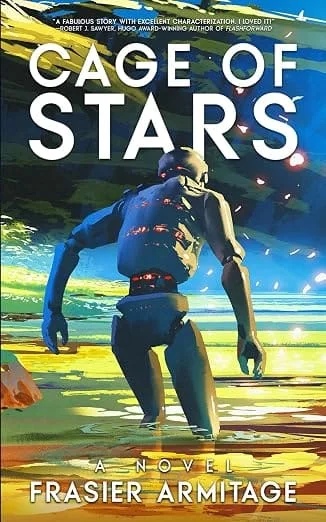
Some books seem to deserve a bigger crowd than they've found, and Cage of Stars is one of them. The reviewer admits they can't tell whether the book has much buzz at all, but they insist it should have more. They also count it among the best books they read this year, which is a strong recommendation from one reader rather than a consensus. Still, the case they make is persuasive enough to put this indie science fiction novel on your radar.
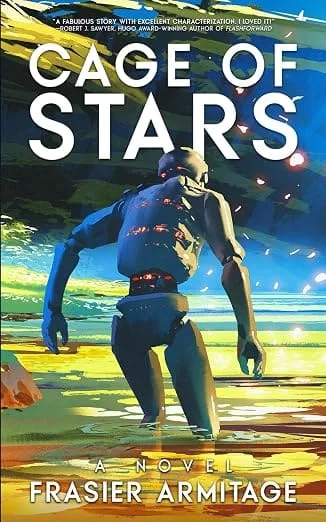
A robot at the bottom of a sphere
The premise is simple to state and hard to put down. Inside a Dyson Sphere, a megastructure imagined as a shell around a star, artificial intelligence has been outlawed and hunted. When a robot is dug up at the equator, it has to run if it wants to survive. Its route takes it across the Sphere toward the pole, where it hopes to reach a place called "Freedom." The book asks how far a being will go to be free, and whether one robot's struggle could change the world around it.
That question carries a lot of weight, and the reviewer's favorite thing about the book may be how it handles it. Instead of following the robot from a single point of view, the story unfolds as a string of encounters. Each person, creature or thing the robot meets gets its own stretch of narration. Some of these viewpoints are human. Others belong to natural features like a river or a tree. The robot moves through the story without ever being the only lens on its own journey.

Why a patchwork structure works here
Books built from vignettes can feel scattered, because each chapter has to earn its place quickly before the reader moves on. Here, the structure serves the theme. A robot defined by what it is forbidden to be becomes visible through how others react to it. A river's view of a machine will differ from a person's, and a tree's will differ again. Each encounter leaves the robot a little more knowable and a little more threatening, and the reader assembles the picture from those fragments. That's a demanding way to write a novel, but when it lands, the reader feels the weight of every stop along the way.
The format also suits a reader who likes to pause between sections and consider what just happened. If you enjoy noticing how the same event looks from different angles, this book gives you plenty of material.

Settings that do a lot of the work
The reviewer singles out the settings as incredibly imaginative, and the range is part of the appeal. The book moves from a tech-driven undercity that never sees the light of the system's star, to a floating forest where gravity is very weak, to a dust-choked pole that is nearly uninhabitable. Each place feels like a different planet's worth of invention packed into one megastructure. Sci-fi readers who like world-building will likely find the environments the most rewarding part.
The creatures follow the same pattern. Some are familiar to anyone who grew up with dinosaurs, such as the stegosaurus. Others are described as completely alien. That mix keeps the setting grounded in recognizable forms while stretching it into unfamiliar territory, and it reminds you that the robot is crossing a living world rather than an empty set.

ScanTech and the question of control
Human societies appear throughout the book, and the reviewer notes that they run the spectrum. Over all of them sits an entity called ScanTech, which controls everything in the robot's world. The reviewer describes ScanTech as anything but forgiving, and points out that the robot's very existence goes against everything ScanTech has built. That setup gives the flight across the Sphere real stakes. Every stop is a question of who will help, who will report, and who will look away.
The reviewer deliberately keeps quiet about what ScanTech actually is, saying that's best left for readers to discover. It's a sensible choice for a review, and it means you'll go into the book without a spoiler hanging over the middle chapters. If you like mysteries layered inside a larger system of control, this will reward your patience.
Who should pick it up
This book suits readers who already enjoy science fiction, especially those drawn to big ideas like megastructures and artificial minds, and to stories that treat a non-human perspective seriously. Book clubs could have a lively time with it, since the rotating viewpoints invite debate about whose perspective feels most true and what freedom means to a river or a tree. The review doesn't go deep into character arcs or pacing, so readers who need those elements front and center may want to sample it first. Based on what the reviewer describes, though, the strongest pull is the premise itself: a robot running across a world built to contain it, and a patchwork of voices deciding what that run means.
If the premise has caught your attention, you can find the book's listing on Goodreads. Just don't expect the answers to come quickly. This is a book that asks you to keep watching the horizon, and it's better for it.