In lane Authors & Interviews
Ginger and Fred Take to the Dancefloor, Cats and Dogs Included
Description
A cat and a Dalmatian dare to dance differently in Seetha Dodd and Elizabeth Stewart's rhyming picture book. The creators share how it came together.
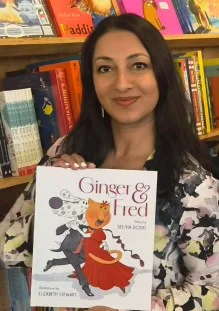
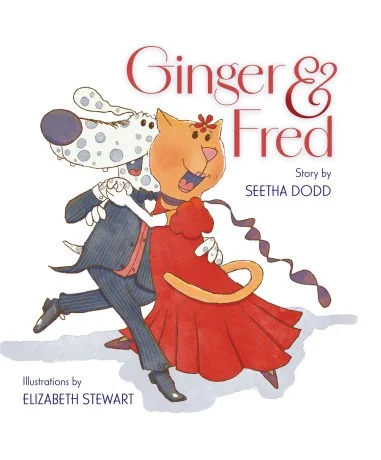
Picture books that tackle exclusion usually lean on heavy-handed morals. Ginger and Fred takes a lighter route. Seetha Dodd's rhyming couplets bounce along, and Elizabeth Stewart's illustrations give every spread a sense of movement and wit. The result is a story about who gets to share a dancefloor, told with enough humour that young readers will be laughing before they realise they're thinking about fairness.

The rule nobody questions
The town of Furrington has a settled way of doing things. Dogs twirl with dogs, cats whirl with cats, and nobody thinks to ask why. The book presents this as tradition so deeply held that it reads as law. Then Ginger the cat and Fred the Dalmatian arrive at the ball with a new style of dance, and the whole hall has to decide what it believes.
What I like here is that the setup is simple enough for a four-year-old and sharp enough for a classroom discussion. The rhyming text carries the premise, and the illustrations do the rest. Seetha has said the story grew from her own experience of adapting to change and from her thinking about how cats and dogs are often cast as enemies. Her question was what might happen if a rebellious pair challenged that assumption. The famous dancing duo of Fred Astaire and Ginger Rogers helped shape the characters, and that film-era glamour shows up throughout the book.
Shock, curiosity, acceptance
Seetha singles out the supporting characters as her favourite part of the book. She describes a clear emotional arc, moving from shock and indignation through curiosity to acceptance, and says she loves seeing that change play out in both the words and the pictures. It's a sensible choice. Stories about inclusion often reduce the bystanders to obstacles. Here they get to change their minds, which gives young readers a model for doing the same.
Seetha also reads the book aloud and enjoys it that way, which matters for a rhyming text. Read-aloud rhythm is hard to fake, and the couplets are built to be performed.
Drawing a dancefloor full of animals
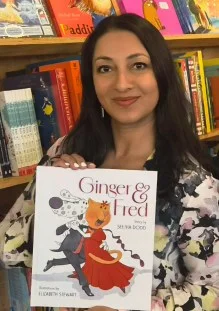
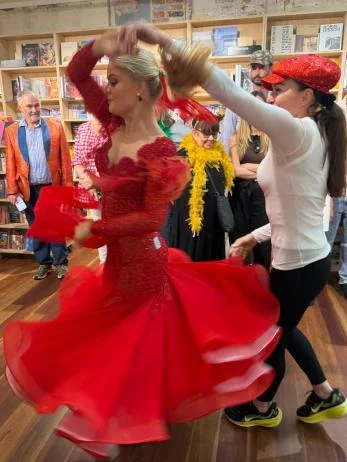
Elizabeth's process is worth a closer look, especially for illustrators working on crowd scenes. She began in pencil, scanned the drawings and placed each figure in a Word document as a cut-out. That let her shuffle elements around, test compositions and make quick changes after feedback. She then redrew everything in Procreate with a pencil brush and built colour with watercolour and texture brushes. Each element uses several layers at different transparencies. Ginger alone uses thirteen layers, which Elizabeth clearly enjoys mentioning.
The method explains a lot about the finished look. The layered colour gives the pages a soft, handmade texture, and the cut-out approach makes the big ball scenes feel busy without becoming muddy. Elizabeth says her love of Richard Scarry shaped the energy of the images. She points to Lowly Worm and his apple car as proof that a picture book can carry big ideas and plenty of humour at once.
Words that are fun to say
Elizabeth's favourite part of the text is the language itself, from "a scandalous tryst" to "ears in a twist." She says she enjoyed building images that help children grab hold of those phrases. That's a smart approach to vocabulary. A child who can picture a scandalous tryst is more likely to remember the phrase and to try it out on a sibling.
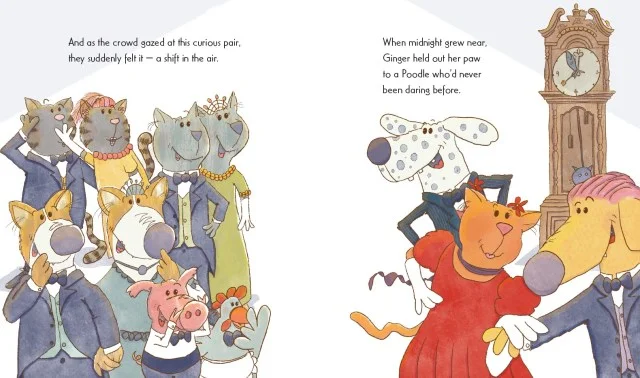
She also says children tend to respond strongly to the big feelings in the book. For her, it opens a path into questions about why some rules exist and how one person's actions can shift a whole group. Seetha's experience with classroom and family readers points the same way. She says children often bring up their own tricky friendships once the story gets them going.
Two first picture books, one publisher
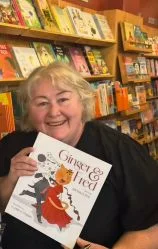
This is the first picture book for both creators, and they're clear about what that means to them. Seetha dedicated the book to her daughter Nikhita, whom she describes as brave and bold in her convictions. Her day job involves talking about change, pushback from doubters and the importance of the first follower, and she sees those ideas playing out on the dancefloor. Denial and intolerance give way to curiosity and acceptance, she says, and that can start with one person or a pair of pioneers.
Seetha also credits the publisher. Maryann Ballantyne, publisher at Wild Dog Books, admits she never expected to say yes to a rhyming story about dancing cats and dogs. Elizabeth, for her part, calls the project a dream come true and notes that Donna Rawlins, the publisher's art director, was one of the first professionals to offer her encouragement years ago. Working with her again felt like a full circle.
How the book came together
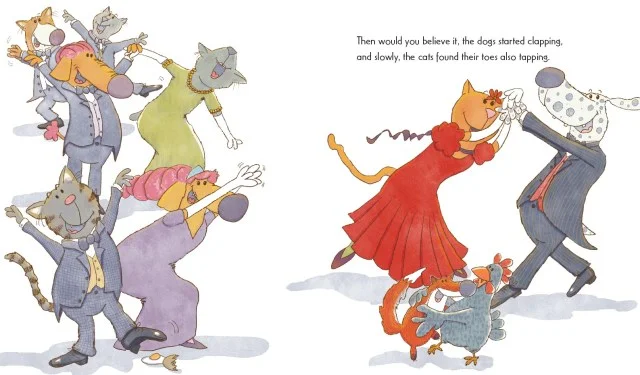
The timelines are revealing. Seetha says the rest of the text arrived quickly once she had the opening couplet, "No one expected a duo like that / Fred the Dalmatian and Ginger the Cat." She estimates about two months of writing overall, with the first draft done over the Christmas break. Illustration took much longer. Elizabeth says it took a while to pin down each character, and once she had the green light, the full set of pictures took about a year. She works full time and has a busy family life, so she built a setup she could carry anywhere. She drew at the park, while watching children at the pool, and while waiting for an appointment with her mother's eye specialist. Most of her serious work happened after the house went quiet.
That kind of stop-start production makes the finished pictures more impressive. Keeping a consistent style across a year of scattered sessions is a discipline in itself.
Where text and pictures meet
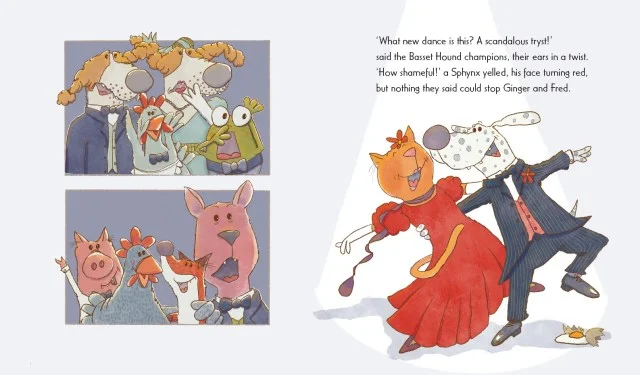
Seetha says Elizabeth built visual layers she could not have imagined while writing the text. She admires the joyful mood, the sense of movement and the cast of characters. She also points to the use of white space, the visual metaphors and a shift in perspective. The spotlight starts on Ginger and Fred and gradually widens to take in the other characters as they change their thinking. Seetha says she keeps finding new details on each reread.
Elizabeth describes her first look at the printed copy. Her favourite example is a clock she drew with fish, cheese and a bone as the hands. The text said the clock was striking midnight, which would have hidden those details. Seetha changed the text so Elizabeth could keep her vision. It's a small edit with a big payoff, and it shows how closely the two worked together. Elizabeth also says she wasn't sure until she held the finished book whether her colour choices and transparent layers would read clearly on the page. She reports no disappointments.
Why the message lands
Seetha hopes the book gives children comfort in a simple idea: be kind to everyone, whatever their appearance or background. She also sees a deeper message for readers who find that standing up for a belief isn't easy. The book tells children that it's fine to question unfair rules, to change their minds as they learn and to stay open to new ideas. Elizabeth says the humour helps. Children get absorbed in the story first and then start asking questions, which is the order she'd want.
Keeping the party going
The publisher's promotional ideas are worth a look for teachers and parents. Wild Dog Books offers Ginger and Fred headbands and colour-in sheets through Teachers Pay Teachers. Beyond the downloads, the creators suggest simple activities: design a poster or invitation for the Furrington ball using the old rules or the new ones, hunt for rhyming word pairs in the story, and write a rhyming poem about dogs and cats built on one or more of those pairs. That last one is a clever way to turn the book's sound play into a writing exercise.
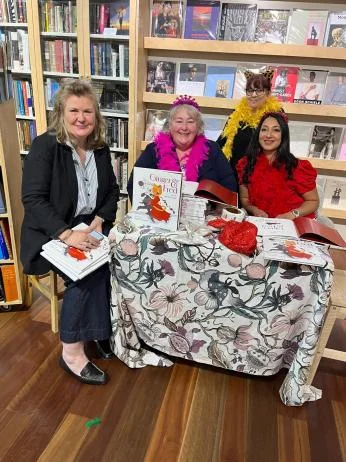
The book is available through Wild Dog Books. Its launch took place at Gleebooks on 19 September, after the book's release on 1 September 2026. For a picture book that makes a case for changing minds, it's a fitting start. My read is that Ginger and Fred will work best in homes and classrooms where adults are willing to read it twice, once for the rhythm and once for the tiny details in the pictures.