In lane Book Reviews
A Court of Splintered Harmony Review: An Uneven Start to Sarah J. Maas’s Valkyrie Cycle
Description
Sarah J. Maas widens the cast and sets a larger conflict in motion, but this opening movement feels short on character growth and payoff.
Rating: /10


A threat that needs a stronger beginning
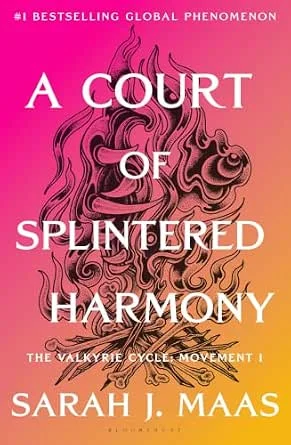
Sarah J. Maas’s A Court of Splintered Harmony: The Valkyrie Cycle, Movement I sets a formidable danger against a court still struggling to recover. Koschei the Deathless, bound to a mountain lake for millennia, is stirring; his influence is spreading through the Fae territories, and powerful allies are seeking to reclaim the human lands. The Night Court faces the task of defending innocents while trying to rebuild alliances and manage fractures within its own ranks.
That premise gives the book plenty to set in motion. The difficulty, for me, is that the story feels more like an opening brief for what comes next than a satisfying novel in its own right. As the first movement of a larger storyline, it leaves the main conflict and its character threads waiting for later installments to gather force. A reader who enjoys long-form setup may welcome the groundwork. I wanted this volume to offer a clearer sense of movement and a more complete payoff before it ends.
The setup also leans heavily on earlier books. I found myself thinking often of A Court of Silver Flames and the fallout of House of Flame and Shadow, with stretches that felt like a return to familiar tensions rather than a substantial step beyond them. That revisiting could help readers reconnect with the series’ existing conflicts, but it also makes the new story feel less distinct. For me, the book’s central challenge is not a lack of material; it’s that much of the material feels held in reserve.
A wider cast, familiar tensions
One welcome choice is the range of point-of-view characters. Azriel, Feyre, Nesta and Cassian all receive perspectives, alongside chapters from Gwyn and Mor. That wider lens creates room to see the pressure on the Night Court from more than one angle, and Gwyn and Mor’s appearances are especially welcome additions to the mix. A larger cast can make a story of fractured relationships feel more textured, though here the added perspectives don’t always translate into the character change I hoped to see.
My strongest reservations concern the familiar characters’ emotional trajectories. Azriel came across to me as intensely self-pitying and withdrawn. Cassian hasn’t regained the spark and playfulness I liked in the original trilogy, while Rhys feels more brooding and distant. Those responses are subjective, but they shape how the book’s ensemble works: with so many people carrying old wounds and new resentments, I wanted more moments that changed the balance between them.
Feyre’s experience of motherhood was a more successful thread for me. The portrayal gives her a dimension that feels carefully observed, and it offers a steadier emotional point amid the cast’s continuing strain. I also appreciated that Elain’s attitude is challenged directly. Still, that confrontation didn’t amount to much character development in this installment. The scene points toward the possibility of change, while leaving the consequences largely unexplored.
Promises that need follow-through
I first read A Court of Thorns and Roses eleven years ago, and I wasn’t won over by A Court of Silver Flames. That history inevitably colors my response here: readers who remain deeply invested in these characters may find more pleasure in tracking every new tension and building theories about what it means. I felt less connected to the group than I once did, so their divisions often landed as a reminder of distance rather than a reason to lean closer.
The compact length—under 400 pages—may also help explain why the book feels so concentrated on setup. Maas’s books have been growing longer, and this installment gives the impression of containing a large set of unresolved threads in a relatively short space. I wondered whether the work might be doing too little to stand on its own, but the book doesn’t supply enough evidence to settle what the larger plan is. For now, that question remains part of my frustration rather than a conclusion about the author’s intentions.
One line about “building a wall” particularly caught my attention. I found it an odd fit in the story as presented, and the book doesn’t do enough with it to clarify why it matters. Perhaps a later installment will give the comment a different meaning; at this stage, that would be a promise rather than a payoff. The same is true of several of the book’s other tensions: there’s potential in the fractures, but the next movement will need to develop them with greater purpose.
My verdict is mixed. The expanding cast, the threat surrounding Koschei and Feyre’s portrayal of motherhood offer points of interest, but the story’s reliance on setup and its limited character growth left me underwhelmed. Lucien, in particular, deserves better. Readers already eager to follow the next stage of the series may find enough here to keep theorizing; readers looking for a self-contained arc should know that this volume leaves much of its promise for later.