In lane Authors & Interviews
Mark Carthew’s Bert & Billy Brings Folktale Playfulness to a Story of Friendship
Description
Mark Carthew and Shane McG reshape troll folklore in Bert & Billy, a read-aloud picture book about kindness, connection and wordplay.
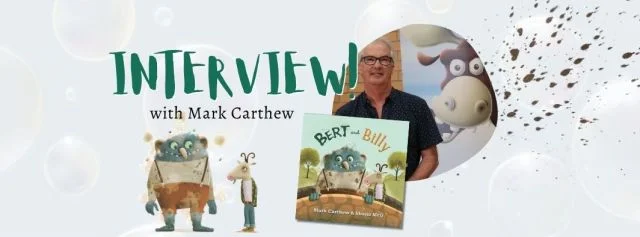


A troll who wants to be liked gives Mark Carthew a fresh way into familiar folklore. In Bert & Billy, the author pairs a lonely troll with a young billy goat, building a funny, rhythmic picture book around friendship and the chance to look beyond first impressions. Carthew’s wordplay and Shane McG’s expressive illustrations are designed to make the story inviting to read aloud and revisit.

A troll with a different aim
Carthew says his affection for traditional stories, folk tales and fairy tales helped spark the book. The story took shape while he was developing his self-publishing imprint, Leaping Lizards Press. As often happens in his picture-book writing, he began with possible titles, alliteration and phrasing; from there, the story’s movement came quickly. He compares that rush of ideas to songwriting and a rainstorm: once the flow begins, it can pour.
Each word and rhyming phrase, he says, needs a reason to be there and must sound natural when spoken. That attention to the ear suits a story built for shared reading, with playful sounds and opportunities for children to anticipate and join in.
Carthew also drew on a family connection to Norway, wondering whether that distant heritage helped make trolls a natural subject. In familiar portrayals, trolls often appear as threatening figures. He wanted Bert to be different: a character seeking friendship and positive contact with the outside world, rather than looking to hurt anyone. The book’s quiet challenge to assumptions sits alongside its humour and folklore echoes.
The connection to The Three Billy Goats Gruff starts with the names. Carthew wanted the characters’ names to connect through sound and logic, which led him to Bert and Billy. The alliterative pairing nods to the well-known tale while giving this story its own focus.
Sound, performance and read-aloud rhythm
Rhyme, Carthew explains, grew from his enjoyment of poetry and songwriting. It has become a natural mode for his books for children, though he sees it as difficult to handle well: a rhyme can feel forced if the phrasing does not sound effortless. His experience writing songs, plays and school musicals while working as a primary teacher helped shape the lyrical quality of his picture books.
That performance background also informs how he presents stories. Carthew likes to create interactive songs to accompany his books, adding another way to engage children during school visits and speaking events. In the text itself, he uses spoken call-and-response moments and bursts of onomatopoeia. Repetition and prediction invite children to listen closely, join in, and play with the sounds of language.
For Carthew, the entertainment is part of the point. He hopes readers will enjoy the comic wordplay again and again, while also finding a story about empathy, kindness and taking care of one another. Billy helps Bert face loneliness and encourages readers to reconsider what they assume about someone from their appearance or circumstances. The message is present without making the book’s fun secondary.
Designing a friendly Bert
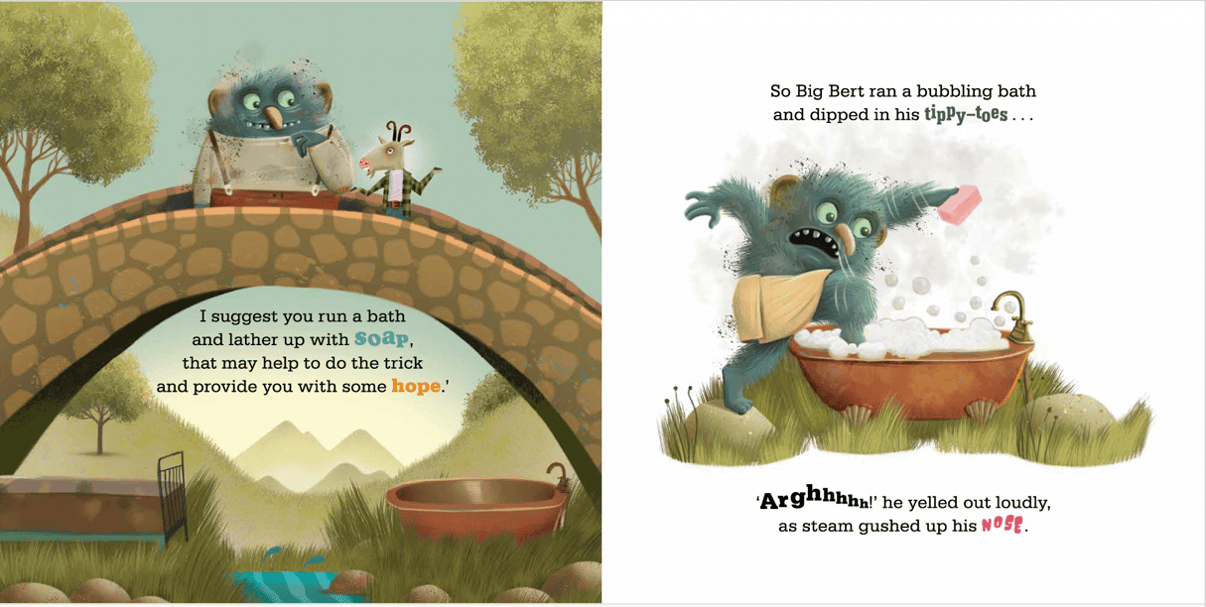
Bert’s appeal was a particular focus for Carthew and McG. Since the troll’s wish for connection drives the story, his appearance needed to feel approachable. Carthew says that living beneath a bridge, and having some personal and environmental cleanliness problems, made sense for Bert’s situation. That detail also gives Billy a reason to offer advice and sets up one of Carthew’s favourite sequences.
Early sketches gave Bert pointed ears. Carthew felt rounded ears softened the character’s look and connected more closely with traditional Scandinavian and Norwegian troll imagery. He also notes the number of the troll’s fingers and toes as part of that folkloric design. McG’s finished Bert, in Carthew’s view, has the friendly quality the story needed. Billy, meanwhile, was drawn to look like a young teenager, a choice intended to help the book speak to readers across a wider age range.

Carthew especially enjoys the build-up to Billy’s suggestion that Bert take a bath, with its natural-sounding rhymes and alliterative phrases. He says McG captures the playfulness of both the language and the bath scene, and praises the illustrator’s use of perspective throughout the book.
A creative partnership with room for visual play
Carthew and McG had already worked together on The Thing That Goes Ping!, which received the Speech Pathology Australia Book of The Year Award. Carthew says that earlier collaboration helped establish a strong working relationship. He values McG’s ability to convey character and feeling, as well as to stage action with a sure sense of design and placement.


The book’s visual language also reflects the work of editor Helen Bethune Moore and designer Joanne Marchese, whom Carthew credits alongside McG. Marchese’s design uses colour and the placement of key rhyming and breakout words to make language visible on the page. Carthew describes the effect as a kind of calligram, recalling the shapes and arrangements used in concrete poetry.





Those choices give children another way to follow the sounds and patterns, connecting what they hear with what they see. Carthew also singles out the endpapers, an element he particularly enjoys. Together, the text and design point to a book that treats read-aloud performance as more than simply reading the words on the page.
About the creators
Dr Mark Carthew is a children’s author, poet, playwright, musician and educator whose work often celebrates oral language and wordplay. His picture books The Gobbling Tree, illustrated by Susy Boyer, and The Thing That Goes Ping!, illustrated by Shane McG, both received the Speech Pathology Australia Book of the Year Award.

Find Mark Carthew at markcarthew.com.au, on Instagram and on Facebook. Find Shane McG at www.shanemcgworld.com and on Instagram.
BERT & Billy is available through Leaping Lizards Press and Simon & Schuster. Carthew’s description of the book points to its central pleasure: a lively shared read, carried by memorable sounds and a friendship that grows when someone takes the time to understand.