In lane Authors & Interviews
Guest Post: From Stage to Page: What Acting Taught Me About Writing Characters by R.A. Neddow
Description
From Stage to Page: What Acting Taught Me About Writing Characters Written by R.A. Neddow Building Characters from the Outside In I have always loved telling stories, but before becoming a writer and ...

From Stage to Page: What Acting Taught Me About Writing Characters
Written by R.A. Neddow
Building Characters from the Outside In
I have always loved telling stories, but before becoming a writer and novelist, my love was expressed through acting. You meet quite interesting characters in acting, both fictional and real. A great deal of the work I did in acting has impacted the way I create characters as a writer.
Character work was always the first thing I started with as an actor receiving a new script (and is also where I start as an author). There are so many questions to be answered in the beginning. Usually, you are given several facts from the script: what they do for work, who their close friends are, who their enemies are, etc. As an actor, my job was to fill in the finer details and really bring any given character to life. This skill has translated over to my writing. But what, exactly, makes up this skill?
The summation of character work in both acting and writing: asking and answering the relevant questions.
The physicality: acting as a character involves a great deal of physical work that writers do not normally do. An actor must fully immerse themselves in the way of a character.
Start with the Way They Move
The basic questions I learned to ask myself in acting include: How do they walk? Fast? Slow? Do they have a limp? Do their feet turn out? How long is their stride? Do they walk more on their forefoot and toes or from the heel? Are they wearing heels or special shoes? Do they have a skip in their step? Where do they walk from? Do they walk from their knees or hips? From their chin? Forehead? What does their walk say about them? Try out these different walks, and any others you can think of, and note how they make you feel.
When I was working with my FMC, Jabrael, who was born and raised the Imperial Crown Princess of her people, I balanced a book on my head while I walked, sat, knelt, and went up and down stairs. I focused on graceful, composed movements, and I found that a collected sort of calm worked through me during these practices. Once I learned how to balance my book with a certain fluidity, I started to lead every movement from my eyes, as Jabrael’s eyes are always the first part of her to move. She is a very cerebral character: thoughtful, observant, curious, aware. I could really embody her movements after executing these exercises.

A few more questions on physicality: How do they sit in a chair? With an ankle over their knee? Legs crossed at the ankles or knees? Both feet flat? Do they manspread? Slouch? Sit tall? Lean back? Try putting yourself in these different positions and see how you physically feel. Which positions make you feel relaxed and at ease? Which make you feel confident and sociable? Powerful? Elegant and refined? Shy or nervous? Closed-off vs. open body language? When you write your scenes, sit like you imagine your character does. See what that feels like.
Jabrael tends to have open body language. Her facial expressions, however, are almost always closed. She holds her cards close. Her poker face is regal, reserved, and a little cold. She does not cross her legs when she sits, but keeps her knees and ankles touching. She has immaculate posture and a refined presence.
The Small Physical Details
Even more questions: How else do they move? Are they fidgety/shifty or usually still? Do they do little stretches? Crack their knuckles? Tap their fingers or toes? Bounce their knee? Pick at their nails? Bite them? Play with any jewellery they wear? How do they breathe? Deeply? Shallowly? Do they smoke? And how does their body language change when it has been a while since they had one? Where does this character hold their tension? Do they have pain anywhere? Do they break out into dance whenever they can? Do they constantly push their hair back or tuck it behind their ears? How much eye contact do they make? Jabrael was trained to make solid eye contact. How do these things change depending on who is in the room with them? How do they act when they are alone vs. surrounded by people? These sorts of questions that I asked as an actor have really helped me paint a full picture of my written characters.
Finding the Character’s Voice
Once I have the character’s posture and movement sorted, I move on to the way they talk. Do they have a grounded way of speaking? A full voice? A nasal voice? Is it high and flutey or low and bass? Do they speak with an accent? A lilt in their cadence? Do they have a loud voice? A soft voice? How often do they speak? Do they ramble or serve words like gourmet dishes? Are they careful and controlled, or do they just throw the words out there?
Jabrael is trained in speaking and singing. She knows how to project her voice, and her natural speaking cadence has a musical quality to it. She often hums and sings. She knows how to command a room with her voice, though she prefers to observe rather than engage, to read words rather than speak them. She is shy and choosy about her words.
Writing the Same Character at Different Points in Their Life
My book has a dual-timeline narrative, and the character you see in both is Jabrael. In the present timeline, she is so aware and cognizant of how she moves and speaks because she knows what movements or tones will give her away. She is practised and controlled to a T. Her past self is similar in a lot of ways. She is not often reactive, though at times her emotions get the better of her and she lashes out, like most young people. She is still aware of how she comes across, yet has not developed the manipulative side of her behaviour yet, which you see in the present timeline. Her present self works more from her head, whereas her past self acts with both her head and her heart. And that is the journey the series will take the reader on. As Jabrael develops, her character shifts from that girl to the dangerous, sly woman seen in the present chapters.
So much of character work as an actor is your ability to put yourself in another person’s shoes, which I think really relates to writing characters that feel real. If you embody them yourself to the best of your ability, then they will feel lived-in and alive. You will hear them more clearly, and they’ll be able to show up in your scenes as complete beings.
Seeing Your Character Through Someone Else’s Eyes
One of my favourite exercises as an actor was done with a partner. The two of us went to the mall to do what is called an Adjective Survey. The survey had adjectives under three different categories: Feelings, Personality, and Appearance. We also asked people to state how old they thought the person was. Here’s how it worked: Partner 1 would wear a specific outfit they wanted people to comment on. They would sit or stand as the character they were looking to portray. Partner 2 stopped people of a variety of ages and asked them to complete the survey. We did ten sheets per look (surveying ten different people), then compared the results and added them up to make a master sheet for that particular look. This gave us a number of perspectives we wouldn’t otherwise get, from a wide range of people. It also allowed us to compare and contrast the perspective of a forty-five-year-old man with that of a twenty-five-year-old woman.
You can do the above exercise with a drawing of your character. Take a picture of them to a bookstore and ask people there to give their perspective on your character. I’ve attached the survey below.
Scoring the Script
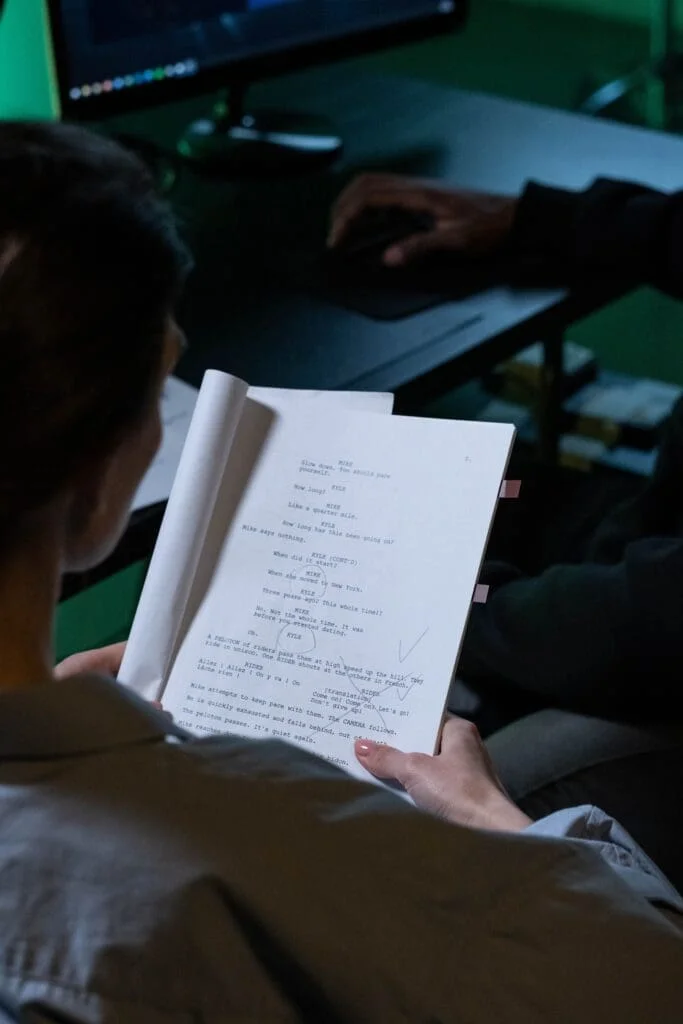
In acting, we did what is called “scoring the script”, where we marked certain words, placed our pauses, justified the lines and movements, and generally came up with how our character would show up and why they would show up that way. Some of the considerations were:
Intention and Motivation
The why questions. Why did they say this or do that? Why did they act in this specific way? Why is this their motivation? Their goal? For example, a character whose sibling was killed by someone who got away becomes a detective and solves murder cases. They want to catch every killer because no one caught the killer of their sibling. They don’t want anyone to have the same awful experience they had. They crave answers. This is the why that fuels their actions and emotions.

Action and Emotion
The what questions. What are they experiencing, and how do they show it? We know why; now we need to see how this translates into their daily life. How do people act, and what do they look like, when they are in a specific state? Using the example above: Are they a workaholic? Do they push their limits to solve the crime? What does that look like? Too much coffee, too little sleep, a short fuse for their anger? Neglected appearance? Same clothes for a week? Greasy and smelly from a lack of shower breaks? What does it feel like to not shower for a week? To not sleep enough? The brain fog, the gritty, oily skin, the dry eyes, the heightened emotional reactivity, the sluggish physical reactivity, the clumsiness, the disconnect, the foul mood. What other action or emotion would surface? Where does this create conflict in their lives? Does their exhaustion cause them to make mistakes or miss things?
What One Says vs. What One Wishes to Say
Countless times, I’ve come across characters who say what they think someone wants to hear. When I came across a character like this in acting, I always wrote what they really wanted to say in the margins, allowing that to influence the way I delivered the line. Think of characters who are asked if they want ice cream, but they are on a diet, so they say no, but you can hear that they want to say yes in the way they say it. Their no isn’t a lie, per se; they don’t want to break their diet, but it isn’t fully true, either. People speak like this a lot. It’s actually very rare that you come across someone with such strong conviction that you never question whether their no holds a little yes or vice versa. This sort of character work can help you create believable miscommunication. How many people hear a no in your character’s yes? A yes in their no? How does that impact the way they behave?
Balance vs. Imbalance
What does your character’s life look like when it is in balance? How does it become imbalanced? Has your character’s life ever been balanced? Do they know what that looks like? Or have they always been searching, yet never able to find what they’re looking for? How does that impact the way they see their life?
Knowns vs. Unknowns
How do they deal with uncontrollable circumstances? A war draft? Getting fired? A death? A betrayal? Someone gets stabbed and is bleeding out? How do they deal with the actions of someone that they don’t like? Those of someone that they do like? Are they more of an observer, or are they a joiner? A doer? Would they be the person watching the stabbed person bleed, or would they be present enough to save the person’s life? Why are they that way?
Passion and Drive
Let’s say I must act as Hitler in a movie. Personally, I have no love for Hitler. I wish he’d never been born. I believe Hitler was a terrible person who massacred innocent people. I can’t relate to him and his wants at all, which makes his character difficult for me to embody. As an actor, you must find a way to relate to each character you play. The same goes for writing characters. If you can’t relate to them, how will your readers?
Relating to evil characters is not easy, but relating to someone who feels desire is. We can point to a lot of qualities that made Hitler who he was, but it was his passion and his drive that turned him into a powerful tyrant. He knew what he wanted, he desired it passionately, and he let it fuel him to accomplish terrible things on a massive scale. His reach went farther than many guessed it would. It was his commitment and passion that drove him to such an extent, and this is something both writers and actors need to understand on a deep level to portray divisive and extreme characters in a believable fashion. There are numerous layers to a person’s passion and drive that we must seek to discover. How far is someone willing to go to get what they desire? What are they willing to sacrifice? How does this create conflict, both internally and externally? How do they justify their actions? What made them desire this?
Wants vs. Needs
What “needs” does a character have that others might classify as a want? For example, most of us would call coffee a want, but ask Lorelai Gilmore and she’ll come at you with: “Is oxygen a want?” It’s a very relatable statement for other caffeine addicts. Whether a person is fighting for what they need or what they want changes the intensity of a situation. Defining what most would call a “want” as a “need” is a great way to create individuality in a character. The language they use changes, their tone changes, their physicality changes. The stakes are higher, which creates greater emotional intensity that sparks intrigue in viewers/readers. When it comes to wants/needs, both the job of the actor and the job of the writer come down to expression.
Expression
Expression encompasses everything I’ve talked about so far, and so much more. There are so many ways for a person to express themselves, which is why there are an infinite number of characters out there. Understanding the way your character expresses themselves is vital to how you have them show up in your scenes. Expression is everything from how they move, speak, work, play, love, dress, and accessorize; it’s how they show up in the world. And this is what both actors and writers aim to do: make their characters truly show up.
Power Dynamics
Obviously, in writing you are the director, writer, and creator of every aspect of a character. In acting, you are given what your character says and must work with a director and an ensemble of other characters, some of whom may be played in ways you never imagined. Your vision of your own character changes based on that outside input.
As a writer, you are playing every character, so you need to get into the motivations and intentions of each one. You need to really embody their feelings, needs, and wants. It makes it easier to understand their reactions and responses to any given situation.
The Public Face and the Private Face
With characters, you have the face they show the group and the face they wear on their own. That is an important part of writing believable characters: the parts they show vs. the parts they don’t. What do they control, and what do they let go of?
Who Has the Power?
This is where understanding power dynamics comes in handy. Think of an employer and employee, where status would suggest the employer has more power because they can fire the employee. You can turn this around, though. If the employee is indispensable because of a special skill they have, that gives them more power and changes the assumed dynamic.

In acting, when I entered a scene, I knew who my character had power over, who they stood equal with, and who held power over them. It changed the choices I made in the way I presented my character.
Translated to writing: understand the relationships between every character in the room, whether they are physically present or just being discussed. If you understand who has power, you will understand how to work a scene.
A few questions to ask during character creation: How does this character act when they are alone? When they are with company, they are not comfortable expressing themselves around? With the people they are most comfortable expressing themselves around? With company they don’t like? With company they do like? Who are they when the power shift is in their favour vs. when it is in someone else’s? What about when the power is equal? A detailed description in each of these areas when drawing up your characters will help you do your characters justice in each scenario they are in.

When Expression and Emotion Do Not Match
I’ve found that a lot of people’s expressions don’t match their emotions. Some people look angry when they feel embarrassed or ashamed. Some people laugh in the presence of tension, whether it’s good, bad, serious, or sexual. They just laugh. Sometimes emotions just need to get out. It’s the job of both the actor and the writer to justify these expressions.

I was watching a reality TV show recently (don’t judge me), and one of the people on there smiled no matter what he was feeling. If he was angry, he smiled. If he was annoyed or frustrated, he smiled. If he was shocked, he smiled. If he was happy, he smiled. No matter his emotion, this man smiled. The exceptions were when he was by himself or when someone else was in distress and smiling would have made him look like a wanker. It was like he thought a smile was the best way to get through unscathed. It was his poker face, his mask. I thought that was interesting. He’d be smiling, and I’d look at his eyes and think he’s annoyed as fuck right now. And you could tell he confused people. They would take him at face value and believe everything was fine, that he was fine, when he wasn’t. It seemed to be a defence mechanism for him, and it ended up shifting the power to him more often than not. People couldn’t tell what he was truly thinking or feeling, which gave him an advantage. He confused people, and that gave him power. He was interesting to watch.
And then, sometimes emotions are straightforward and there is no subtlety to them at all.
Putting the Power Struggle on the Page
In the beginning of my book, The Iron Chest: A Single Brightness, I have two characters who do not like each other and are dealing with a power struggle. He is her master; she is his student, but she went behind his back to do something she believes is right. He’s taken over the situation, which is not how she intended things to go, and so the dynamic between the two is tense because they both want power over the other and over their current situation. To represent this, I made their conversation very stilted. Their dialogue doesn’t flow, their body language is closed off, and neither of them is happy. However, as much as they dislike each other, they still know each other well, so they make astute and incisive observations without questioning whether the other person is lying. There is some trust there even with all the dislike and power struggles. They are both angry with the other as well, so they say things to each other that they normally wouldn’t. They are both a bit bolder in their anger, which is not uncommon in people.
Embodying Different Kinds of Emotion
My acting tools came in when I sat with each character separately and felt their differences. He holds anger in his pelvic region, from his balls. She feels anger from her heart and head. His anger is more primal; her anger is more heartfelt and calculated. He is more prone to outbursts and mockery, and there is a reactive heat to his anger. She is colder, prone to stillness and choice words, more responsive than reactive. Experiencing these two types of anger in yourself feels vastly different, and that difference allows you to show them more effectively in your writing.
More on Character, Writing, and Amereld
Thank you for reading about some of the character work I carried with me from acting into writing. There are countless questions you can ask when building a character, and these are only some of the ones that have helped me understand mine more deeply.
About R. A. Neddow

R. A. Neddow is the author of The Iron Chest, the first book in the Amereld Series, an adult epic fantasy series centred on court intrigue, forbidden magic, complicated loyalties, and morally complex characters.
Before becoming a novelist, she worked as an actor, and much of the character work she learned through acting now informs the way she approaches writing. Her work focuses heavily on character, psychology, physicality, and the complicated space between what people say, what they mean, and what they want.
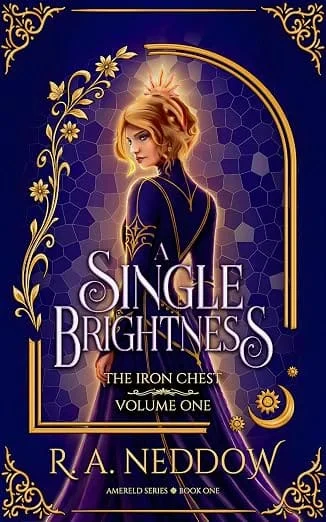
The Iron Chest: A Single Brightness, Volume I of III, is available now in paperback, eBook, and Kindle Unlimited.
Find out more at http://www.raneddow.square.site
If you would like to explore more of her writing, characters, and world, you can find:
- The Amereld Series website Explore the world of Amereld, including character information, maps, and more about the series.
- From Stage to the Page with Rya Neddow I joined José’s Fantasy Talks Live podcast to talk about my acting background, writing, character work, and The Iron Chest.
- The Iron Chest: A Single Brightness Meet Jabrael on the page in Volume I of The Iron Chest, available in paperback, eBook, and Kindle Unlimited.
- Instagram I share character discussions, writing, worldbuilding, artwork, and behind-the-scenes pieces from the Amereld Series at @r.a.neddow.